
Free Teaching Ministry of Thomas Spencer
TheBibleGuy.com
Please click subscribe, I am trying to pass all social media, thanks.

MY latest book reveals these 7 demonically controlled world systems: Political/Governmental, Religious, Educational, Financial, Media, Medical, Military System:
All Kingdom People must untangle themselves from these systems and the key is not to be dependent on them for anything.
Revelation the Final Separation by Thomas Spencer TheBibleGuy.com
In writing the Book Revelation the Final Separation, I encourage questions. Although the scope of my book is to give the simplest path through prophecy of the Bible including Revelation, I do not discuss the many different theories of man’s attempts to understand the Bible, even though I can prove almost all of them with scripture because there is a little truth in each theory. This is the reason I have printed in Chapter Four – 7 General Keys of Bible Interpretation and in Chapter Five – 9 Specific Keys of Prophetic Interpretation.
Since this question showed up, I will compare the theory of Partial Preterism and the principle of Prophetic Duality.
Question: What about “The theory of Partial Preterism?”
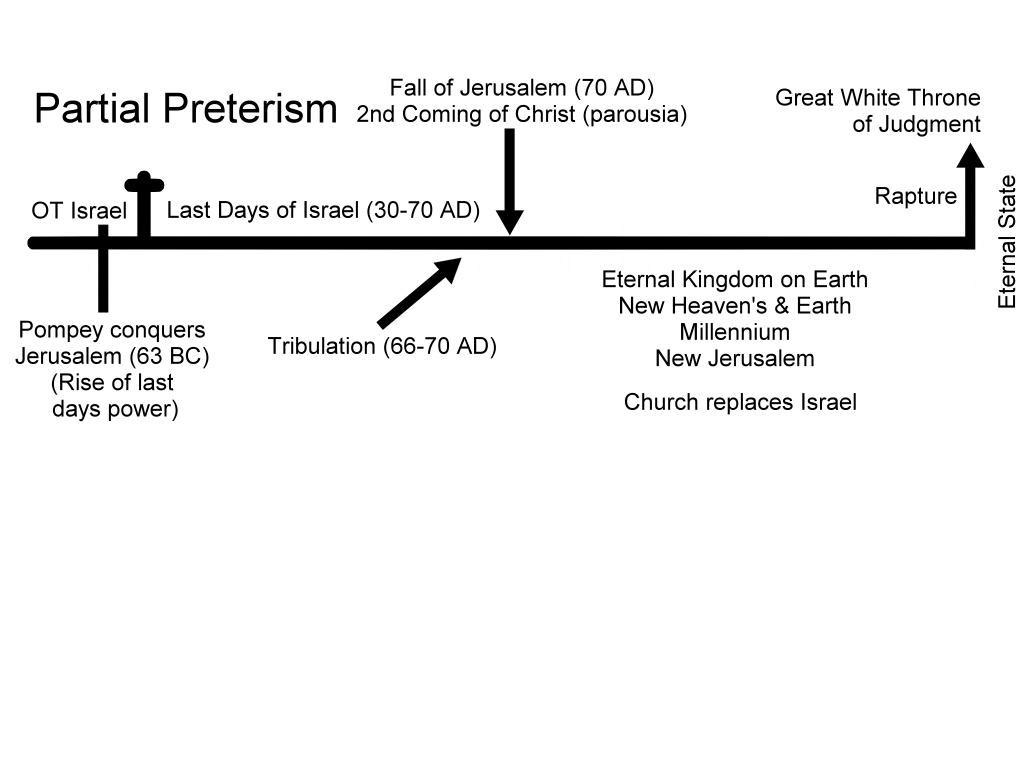
Preterism is the eschatological view that the “end times” prophecies of the Bible have already been fulfilled. So, when we read what the Bible says about the tribulation, we are reading history. Preterism is divided into two camps: full (or consistent) preterism and partial preterism. Full preterism takes an extreme view that all prophecy in the Bible has been fulfilled in one way or another. Partial preterists take a more moderate approach, and many partial preterists consider full preterists to be guilty of heresy.
Those who hold to partial preterism believe that the prophecies in Daniel, Matthew 24, and Revelation (with the exception of the last two or three chapters) have already been fulfilled and were fulfilled no later than the first century AD. According to partial preterism, there is no rapture, and passages describing the tribulation and the Antichrist are actually referring to the destruction of Jerusalem in AD 70 and the Roman emperor Titus. Partial preterists do believe in the return of Christ to earth and a future resurrection and judgment, but they do not teach a millennial kingdom or that Israel as a nation has a place in God’s future plan. According to partial preterists, the Bible’s references to “the last days” are speaking of the last days of the Old Jewish Covenant, not the last days of the earth itself.
In order for partial preterists to maintain their position, they insist that the book of Revelation was written early (before AD 70). They must also use an inconsistent hermeneutic when interpreting prophetic passages. According to the preterist view of the end times, chapters 6—18 of Revelation are highly symbolic, not describing any literal events. Since the destruction of Jerusalem did not involve the wholesale destruction of sea life (Revelation 16:3) or agonizing darkness (verse 10), these judgments are interpreted by the preterist as purely allegorical. However, according to preterists, chapter 19 is to be understood literally—Jesus Christ will physically return. But chapter 20 is again interpreted allegorically by preterists, while chapters 21—22 are understood literally, at least in part, in that there will truly be a new heaven and new earth.
No one denies that Revelation contains amazing and sometimes confusing visions. No one denies that Revelation describes many things figuratively—that’s the nature of apocalyptic literature. However, to arbitrarily deny the literal nature of select portions of Revelation is to destroy the basis of interpreting any of the book literally. If the plagues, witnesses, beast, false prophet, millennial kingdom, etc., are all allegorical, then on what basis do we claim that the second coming of Christ and the new earth are literal? That is the failure of preterism—it leaves the interpretation of Revelation to the opinions of the interpreter.
Those who hold to partial preterism also do not read Matthew 24 in a literal sense. Christ spoke of the destruction of the temple (Matthew 24:2). But much of what He described did not occur in AD 70. Christ speaks of that future time as one of “great distress, unequaled from the beginning of the world until now—and never to be equaled again. If those days had not been cut short, no one would survive, but for the sake of the elect those days will be shortened” (Matthew 24:21–22). Surely, this cannot be applied to the events of AD 70. There have been worse times in the history of the world since then.
The Lord also says, “Immediately after the distress of those days the sun will be darkened, and the moon will not give its light; the stars will fall from the sky, and the heavenly bodies will be shaken. At that time the sign of the Son of Man will appear in the sky, and all the nations of the earth will mourn. They will see the Son of Man coming on the clouds of the sky, with power and great glory” (Matthew 24:29–30). In order for the events of these two verses to have already occurred, Jesus Christ must have returned bodily in AD 70—but He did not. The partial preterist believes that these verses do not refer to a bodily return of Christ but to an appearing of His judgment. However, this is not what a normal, literal reading of the text would lead anyone to believe. It is the “Son of Man” whom people see, not just His judgment.
Partial preterists also appeal to Matthew 24:34 where Jesus speaks of “this generation.” They say that Christ was referring to those living at the time He spoke the words recorded in that chapter; thus, the tribulation had to occur within about 40 years of His statement. However, we believe that Jesus was not referring to the people of His day but to the generation who would witness the events recorded in Matthew 24:15–31. That future generation will witness all of the swiftly moving events of the last days, including Christ’s bodily return (verses 29–30).
The partial preterist viewpoint leads to a belief in amillenialism (or post-millenialism) and is associated with covenant theology. Of course, it rejects dispensationalism. But its main problem is its inconsistent hermeneutic and its allegorizing of many biblical prophecies that are better understood literally. While partial preterism is within the scope of orthodoxy, it is not the majority view among Christians today. [Copied from GotQuestions.org]UST OUT 2024!
*NOTE – I have studied this theory with the spirit of the Bereans: These were more fair-minded than those in Thessalonica, in that they received the word with all readiness, and searched the Scriptures daily to find out whether these things were so. Acts 17:11
Read carefully here as I am writing an error of the Partial Preterism theory.
Here is the major wrong turn; The Partial Preterism Camp believes that the Apostle John wrote the book of Revelation in 60 AD describing Daniel’s last 70th Week, then in 70 AD, the Roman Empire invades Jerusalem and the temple (which was real just as Daniel prophesied). But the major error they teach is that the prophecies of the 7 year tribulation started at that moment in history. Therefore, the error in their teaching is that the prophecy of Daniel’s 70 Weeks and John’s Revelation of Jesus and the tribulation has already been fulfilled.
WE MUST BE FOREVER, NEW WINE-SKINS!
- If you park on one religious, denominational doctrine of man, you will die there.
- Our job as Jesus Followers is to give certain hope to this fallen world and The Bible encases that hope, not as a rule but as spiritual life!
- Prophecy is time released therefore we know more today, because God is revealing more details as these end times are getting closer. Both Daniel and John were told to seal up certain prophecies for they were for the end. Guess what? We are at the end!
Instead of Partial Preterism let’s look at Prophetic Duality
The principle of duality is an element of prophecy we have to be very careful about when attempting to interpret. Prophetic statements sometimes apply to more than one fulfillment; dual applications do exist. But at the same time, it can be a lure, trapping us into a wrong interpretation because God never intended every prophecy to have dual applications.
A prime example of duality is Christ’s first coming to atone for our sins and His second coming to rule as King of Kings. Another clear dual application is Jesus’ Olivet prophecy given in (Matthew 24, Mark 13, and Luke 21). Many of the conditions He predicts to befall Judea shortly after His ascension into heaven are also forming for a repeat performance in our day. Often, we will read of “the day of the Lord” and perceive that it was fulfilled anciently. Then a few verses later, the “day of the Lord” will appear in a setting that could not possibly exist anciently but does now.
For example, (Genesis 3:14-15) some aspects of this prophecy began to be fulfilled almost immediately, but a huge time gap is built right into it. Its main feature, the revelation of the coming Messiah and His work of dealing the deathblow to Satan’s efforts, did not come to pass until four thousand years later. Thus, the prophecy had dual application: One part for the serpent and Adam and Eve happened almost immediately, and its exceedingly more important part was fulfilled later.
God’s Appointed Times or Feasts are prophecies. They are also called “a shadow of things to come” (Colossians 2:17) because they prophesy of a real, future event. They are not now the reality but the shadow. For a shadow to be cast, a reality must exist, and a shadow, if followed, leads to the reality. If God prophesies of something, IT IS SURE!
This is the chart for Prophetic Duality using Daniel’ 70 Week Prophecy – One Prophecy two fulfillments: the first is the “Shadow fulfillment” of yet another future event to come.

Prophetic Duality
*NOTE – The Old Testament Prophets did not “SEE” or understand that there would be two comings of Jesus. The first as the Savior “Lamb” to the slaughter and the second The “Lion” that would finally rule The Kingdom of God. They saw it as all one event. Please read that statement a few times, this is MAJOR!
To explain, start at the top left with 457 BC when Daniel’s Prophecy started.
- He saw the first mountain top which was the 7th Week where Jerusalem and the temple were rebuilt (history records that this really happened).
- The red cross on mountaintop #2 refers to Daniel’s 69th Week, even though Daniel did not live to see it, Messiah was born. The gospels of Matthew, Mark, Luke and John plus other historic records record it in detail that Messiah was “cut off” (Jesus was crucified) but new news, He was also resurrected: Why do you seek the living among the dead? 6 He is not here, but is risen! Remember how He spoke to you when He was still in Galilee, 7 saying, ‘The Son of Man must be delivered into the hands of sinful men, and be crucified, and the third day rise again. (Luke 24:5-7) and raptured to Heaven: Men of Galilee, why do you stand gazing up into heaven? This same Jesus, who was taken up from you into heaven, will so come in like manner as you saw Him go into heaven. (Acts 1:11)
Back to the Mountain Top Chart
Now take a look at the dotted blue line that has the words 1 Prophecy 2 Fulfillments. Daniel did not even see the next mountain top let alone the 2000 year valley in between. From Daniel’s perspective there was no break between Daniel 9:26 and 9:27 or week 69 and week 70. Look again at the chart; Daniel did not see the next mountain top. So what do we have?
One Prophecy with two fulfillments.
Yes it was fulfilled in 70 Ad with the Roman invasion (this was the shadow event) but the real event, the second event will be at the next mountain top. It is still in the very near future. Again for a shadow to be cast, a reality must exist, and a shadow, if followed, leads to the reality.
Thanks for studying; Next Blog – click for Identity in Jesus!
Thomas Spencer – TheBibleGuy.com

 thebibleguyblog